Road to 2026: A Guide to All 16 Host Cities Across USA, Canada and Mexico
TL;DR
- The 2026 World Cup will be staged across 16 host cities in Canada, Mexico, and the United States.
- Travel planning matters more than ever because the tournament spans three countries and several time zones.
- Start with your team's route, then compare match dates before booking transport or accommodation.
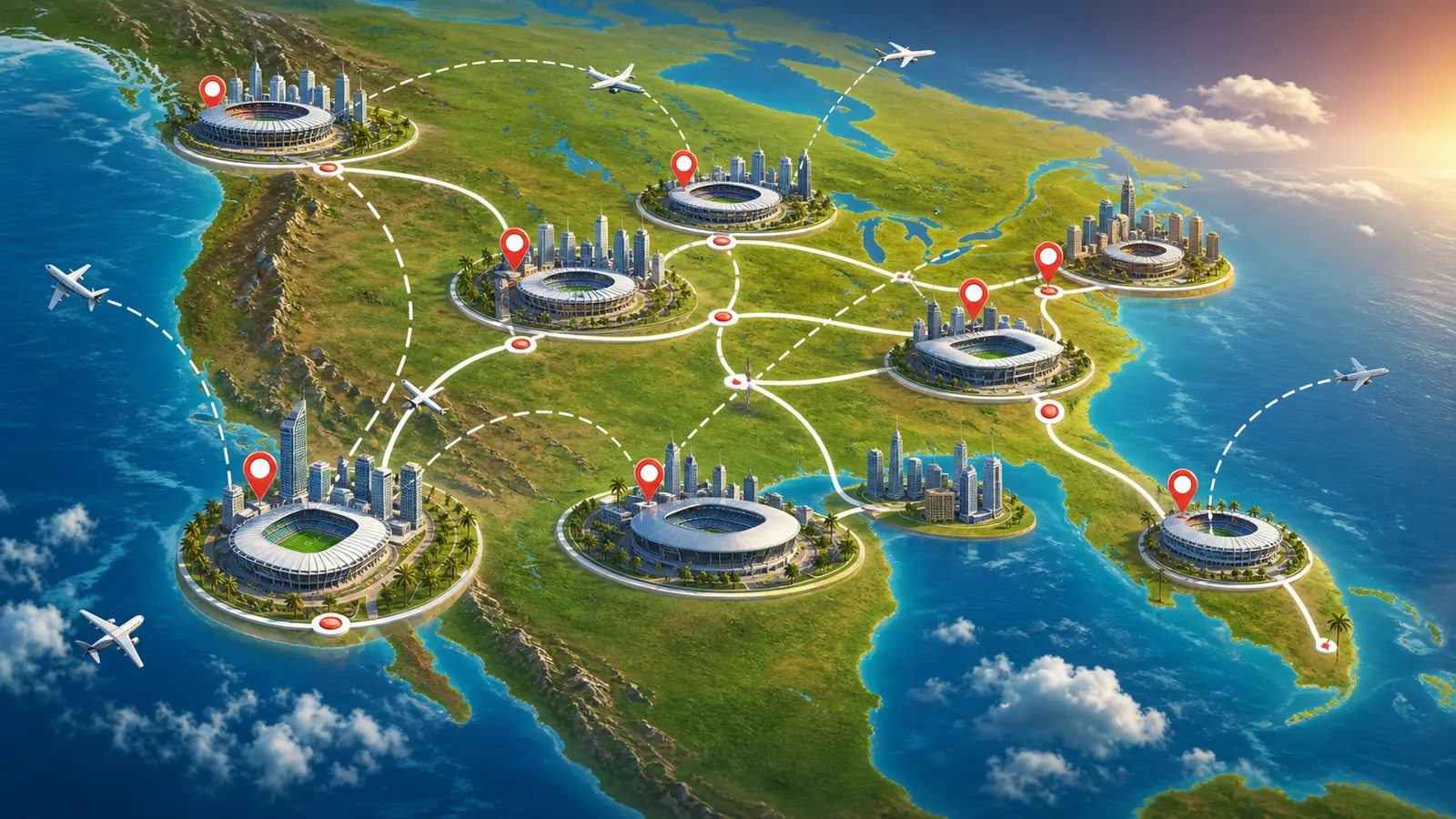
The 2026 FIFA World Cup will be the first to span three host countries — the United States, Canada and Mexico — and the first to feature an expanded 48-team format with 104 matches across 16 host cities. For the global football community, that means more matchdays, more iconic venues, and more local stories to discover than any World Cup in history. This guide walks you through every city on the tournament map, the stadium that will host its matches, and what makes the destination worth visiting beyond the football.
Mexico — Where the World Cup Returns Home
Mexico City (Estadio Azteca)
The legendary Estadio Azteca becomes the first stadium in history to host matches at three World Cups (1970, 1986 and 2026). Located in the southern reaches of the capital, the venue carries the weight of football history — Pelé's third title, Maradona's Hand of God, Italy 1990. Plan a day in the Coyoacán neighborhood for Frida Kahlo's Blue House, then head to the historic center for tacos al pastor and the murals of Diego Rivera.
Guadalajara (Estadio Akron)
Mexico's second-largest city is the birthplace of mariachi, tequila and Chivas — one of the country's most beloved clubs. The Estadio Akron sits just outside the city in Zapopan, offering a state-of-the-art venue with sweeping mountain views. Time your trip with a sunset visit to Tlaquepaque's artisan market.
Monterrey (Estadio BBVA)
The "Stadium of the Steel Giant" is one of the most photogenic venues in world football, framed by the dramatic Cerro de la Silla mountain. Monterrey is Mexico's industrial capital and an emerging culinary destination — try cabrito al pastor, the local specialty of slow-roasted young goat.
Canada — A First-Time World Cup Host
Toronto (BMO Field)
Canada's largest city brings a multicultural energy to the tournament. The expanded BMO Field on the Lake Ontario waterfront will host group-stage matches in a venue that already pulses with Toronto FC supporter culture. Don't miss Kensington Market for international food, the CN Tower for skyline views, and a Blue Jays game at Rogers Centre next door.
Vancouver (BC Place)
Set against the Coast Mountains and the Pacific Ocean, Vancouver may be the most scenic World Cup host on the schedule. BC Place's retractable roof guarantees matches go ahead regardless of weather. Take a ferry to Granville Island, hike Stanley Park, and end with sushi at Tojo's — the city's first true food temple.
United States — Eleven Cities, Coast to Coast
Los Angeles (SoFi Stadium)
The most ambitious sports venue ever built, SoFi Stadium will be the centerpiece of the tournament's American leg. Inglewood is part of an LA football boom that includes Banc of California Stadium and the new Intuit Dome next door. Pair matchday with a morning at the Getty, lunch in Koreatown, and tacos in Boyle Heights.
New York / New Jersey (MetLife Stadium)
MetLife will host the 2026 FIFA World Cup Final — the most coveted match in the global game. Just across the Hudson from Manhattan, the stadium is reachable by NJ Transit train from Penn Station. Build a four-day window around your match for Brooklyn coffee, MoMA, a Yankees game and a Williamsburg bar crawl.
Dallas (AT&T Stadium)
Jerry Jones' billion-dollar "Cowboys Stadium" in Arlington is a tournament-ready venue with the world's largest video display. Dallas is barbecue country — Pecan Lodge is the unmissable benchmark — and the Sixth Floor Museum offers a sobering look at JFK's assassination.
Houston (NRG Stadium)
NRG Stadium is climate-controlled, which matters in Houston's June humidity. The city has quietly become one of America's most diverse food scenes — Vietnamese phở on Bellaire Boulevard, Tex-Mex enchiladas, Gulf seafood in Galveston an hour south.
Atlanta (Mercedes-Benz Stadium)
Atlanta United's home venue features a retractable, pinwheel-style roof unique in world football. The city's civil rights heritage runs deep: the Martin Luther King Jr. National Historical Park and the National Center for Civil and Human Rights are essential visits. Sample Buford Highway for the city's strongest international restaurant strip.
Miami (Hard Rock Stadium)
Miami is the gateway between Latin America and the United States, and the World Cup vibe here will reflect that. Hard Rock Stadium in Miami Gardens is a 30-minute drive from South Beach. Stretch your trip with day trips to the Everglades and Little Havana's Cuban coffee shops.
Seattle (Lumen Field)
The Sounders' home is one of the loudest venues in North American sport. Pike Place Market, the Space Needle and the Chihuly Garden of Glass cover a classic Seattle day, while the ferries to Bainbridge Island offer a quieter escape across Puget Sound.
San Francisco / Bay Area (Levi's Stadium)
Levi's Stadium in Santa Clara serves the entire Bay Area. From there, BART and Caltrain put you in San Francisco proper within an hour. Mission burritos, Tartine Bakery, and a coastal drive down Highway 1 to Big Sur make for a perfect non-match day.
Boston (Gillette Stadium)
Gillette, in Foxboro, has hosted three football codes — NFL Patriots, MLS Revolution and now World Cup matches. Boston itself is compact and walkable: the Freedom Trail, lobster rolls in the North End, and a Red Sox night at Fenway Park.
Philadelphia (Lincoln Financial Field)
Philadelphia's Lincoln Financial Field will showcase one of America's most history-rich cities. Walk the Independence Mall, eat a real cheesesteak in South Philly (Pat's vs. Geno's is the eternal debate), and end your trip at the Philadelphia Museum of Art's "Rocky Steps."
Kansas City (GEHA Field at Arrowhead Stadium)
Arrowhead is famous for being the loudest stadium in the NFL — World Cup atmosphere will be electric. Kansas City barbecue is its own religion: Joe's, Q39, and Arthur Bryant's are the holy trinity. Time it with a Royals game at Kauffman Stadium next door.
Practical Tips for Your World Cup Trip
- Book early. With 48 teams and 104 matches, demand for flights, trains and hotels will be unprecedented. Many fans will follow their teams across multiple cities — plan transfers months ahead.
- Cross-border travel. A trip combining a Mexico City group match with a Vancouver knockout requires careful visa, ESTA and eTA planning. Check entry requirements for all three countries early.
- Time zones matter. The tournament spans six time zones from Vancouver to the Eastern Seaboard. Kickoff times will vary widely — confirm local time for every fixture.
- Stadium transit. SoFi, AT&T and Mercedes-Benz Stadium rely heavily on car or rideshare access. Public transit is strongest in NYC/NJ (NJ Transit), Toronto (TTC), Mexico City (Metro) and Seattle (Sound Transit).
- Fan zones. Every host city will operate official FIFA Fan Festivals during the tournament. These are free, family-friendly, and a great option for non-ticketed matches.
Why the 2026 World Cup Will Be Different
A continental World Cup means a new kind of tournament. Fans can follow their teams from Mexican altitude to Canadian rainforest to American desert heat. The 48-team format introduces 12 groups of four, expanding storylines and underdog opportunities. And with three host federations sharing organization duties, expect a level of operational scale never before attempted in football.
Whatever city you visit, whatever team you follow, 2026 will be a World Cup defined by movement, diversity and discovery. The road begins here — pick your destinations, follow your team, and meet the rest of the football world somewhere along the way.
Looking for more World Cup coverage? Explore all 48 participating teams, check the full match schedule, or take the World Cup IQ Quiz to see how your knowledge stacks up.
Sources and official references
Frequently asked questions
How many host cities are there for the 2026 World Cup?
The tournament will use 16 host cities across Canada, Mexico, and the United States.
Should I book travel based on one city or my team's route?
Start with your team's likely route and confirmed match dates. The three-country footprint makes transport planning important.